


\(ABCD\) is a quadrilateral in which \(W\),\(X\),\(Y\), and \(Z\) are the mid-points of sides \(AB\),\(BC\),\(CD\), and \(DA\) respectively, and \(AC\) is a diagonal.
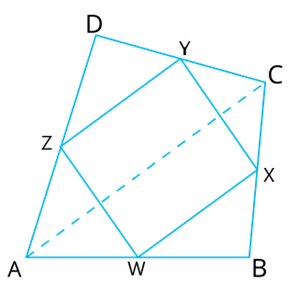
Prove that:
(i) \(ZY\) is parallel to \(AC\) and \(ZY =\frac{1}{2}AC\)
(ii) \(WX = ZY\)
(iii) \(WXYZ\) is a parallelogram.
Solution:
(i) To Prove: \(ZY || AC\) and \(ZY =\frac{1}{2}AC\)
Proof:
Here, taking \(∆ACD\) we can see \(Z\) and \(Y\) are the mid points of side \(AD\) and \(DC\) respectively. [Given]
By , 'The line segment joining the mid-points of two sides of a triangle is parallel to the third side and is half of it.'
Hence, \(ZY || AC\) and \(ZY= \frac{1}{2} \) ------\((1)\)
(ii) To Prove: \(WX = ZY\)
Proof:
Now here, taking \(∆ACB\) we can see \(W\) and \(X\) are the mid points of side \(AB\) and \(BC\) respectively. [Given]
By , 'The line segment joining the mid-points of two sides of a triangle is parallel to the third side and is half of it.'
Hence, \(WX || AC\) and \(WX = \frac{1}{2} \) ------\((2)\)
From (1) and (2) we can say,
\(WX = ZY\)
(iii) To Prove: \(WXYZ\) is a parallelogram
From (i) and (ii) we can say that \(WX || AC\) and \(ZY || AC\) so, \(WX || ZY\) and \(WX = ZY\).
Proof:
If each pair of of a quadrilateral is equal, then it is a .
Hence, \(WXYZ\) is a parallelogram.