

Properties of a right angled triangle:
Pythagoras theorem:
In a right triangle, the square of the hypotenuse is equal to the sum of the squares of the other two sides.
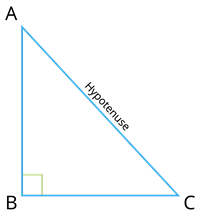
The theorem states that in the right-angled triangle \(ABC\), \(AC^2 = AB^2 + BC^2\).
Converse of the Pythagoras theorem:
In a triangle, if the square of one side is equal to the sum of the squares of the other two sides, then the angle opposite the first side is a right angle.
In the triangle ABC, if \(AC^2 = AB^2 + BC^2\) then, the angle opposite to the side \(AC\) is the right angle.
That is, \(∠B=90^{\circ}\).
That is, \(∠B=90^{\circ}\).
Properties of a tangent to a circle:
Tangent:
If a line touches the given circle at only one point, then it is called a tangent to the circle.
Result 1:
A tangent at any point on a circle and the radius through the point are perpendicular to each other.
Result 2:
- No tangent can be drawn from an interior point of the circle.
- Only one tangent can be drawn at any point on a circle.
- Two tangents can be drawn from any exterior point of a circle.
Result 3:
The lengths of the two tangents drawn from an exterior point to a circle are equal.
Result 4:
If two circles touch externally, the distance between their centres equals the sum of their radii.
Result 5:
If two circles touch internally, the distance between their centres equals the difference in their radii.
Result 6:
The two direct common tangents drawn to the circles are equal in length.
Alternate Segment Theorem:
If a line touches a circle and from the point of contact a chord is drawn, the angles between the tangent and the chord are respectively equal to the angles in the corresponding alternate segments.
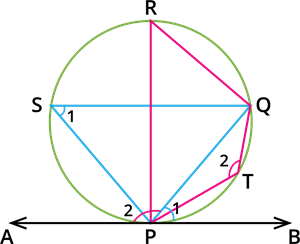
In the figure, the chord \(PQ\) divides the circle into two segments. Then, the tangent \(AB\) is drawn such that it touches the circle at \(P\).
Thus, the angle in the alternate segment for \(∠QPB\) is \(∠QSP\) and that for \(∠QPA\) is \(∠PTQ\) are equal.
Then, \(∠QPB = ∠QSP\) and \(∠QPA = ∠PTQ\).