

State and Prove Pythagoras theorem.
Statement:
In a right triangle, the is equal to the .
Explanation:
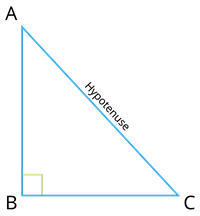
The theorem states that in the right-angled triangle \(ABC\), .
Construction:
Construct a line from \(B\) to \(AC\) to intersect at \(D\) such that \(BD \perp AC\).
Proof:
Given, a triangle right angled at \(B\).
That is \(\angle ABC\) \(=\) .
That is \(\angle ABC\) \(=\) .
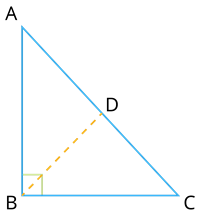
Consider the triangles \(ABC\) and \(BDC\).
Here, is common.
And, \(\angle ABC = \angle BDC\) \(=\) [Since ]
Thus, \(\Delta ABC\) \(\sim\) \(\Delta BDC\) [By ]
Hence, the ratio of the .
That is, \(\frac{BC}{CD} = \frac{AC}{BC}\).
This implies, \(BC^{2} =\) ……\((1)\)
Now consider the triangles \(ABC\) and \(ABD\).
Here, is common.
And, \(\angle ABC = \angle ABD\) \(=\) [Since ]
Thus, \(\Delta ABC\) \(\sim\) \(\Delta ABD\) [By ]
Hence, the ratio of the .
That is, \(\frac{AB}{AD} = \frac{AC}{AB}\).
This implies, \(AB^{2} =\) ……\((2)\)
Add equations \((1)\) and \((2)\) as follows:
\(BC^2 + AB^2\) \(=\) \(=\) \(AC^2\).
Hence, proved.