

The perpendicular \(LO\) on the base \(MN\) of a \(\Delta LMN\) intersects \(MN\) at \(O\), such that \(MO\) \(=\) \(3\) \(ON\). Derive that \(2\) \(LM^2 = 2LN^2 + MN^2\).
Proof:
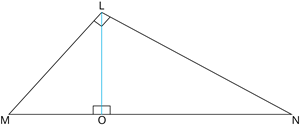
From the figure we have, \(MN\) \(=\) \(MO\) \(+\) \(ON\).
\(\Rightarrow\) \(MN\) \(=\) [Given]
\(\Rightarrow\) \(=\) \(\frac{MN}{4}\) \(……. (1)\)
Substitute equation \((1)\) in \(MO\) \(=\) \(3\) \(ON\).
\(\Rightarrow\) \(MO\) \(=\) \(3\) \(\times\) \(\frac{MN}{4}\)
\(\Rightarrow\) \(MO\) \(=\) \(\frac{3MN}{4}\) \(……. (2)\)
\(\Rightarrow\) \(MO\) \(=\) \(3\) \(\times\) \(\frac{MN}{4}\)
\(\Rightarrow\) \(MO\) \(=\) \(\frac{3MN}{4}\) \(……. (2)\)
Consider the right triangle \(LOM\).
We have, \(…… (3)\) [By Pythagoras theorem]
Consider the right triangle \(LON\).
We have, \(…… (4)\) [By the Pythagoras theorem]
Subtract equation \((4)\) from \((3)\).
\(LM^2 - LN^2 =\)
Substitute equation \((1)\) and \((2)\) in the above equation.
\(LM^2 - LN^2 =\)
\(2LM^2 - 2LN^2 = MN^2\)
\(2LM^2 = 2LN^2 + MN^2\)
\(2LM^2 = 2LN^2 + MN^2\)
Hence, proved.