

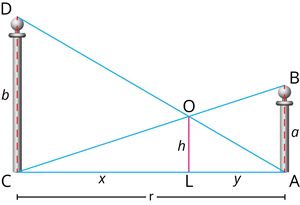
Two poles of height '\(a\)' metres and '\(b\)' metres are '\(r\)' metres apart. Check that the height of the point of intersection of the lines joining the top of each pole to the foot of the opposite pole is given by \(\frac{ab}{a + b}\) metres.
Proof:
Let \(AB\) and \(CD\) be two pole of height '\(a\)' metres and '\(b\)' metres respectively such that the poles are '\(r\)' metres apart. That is, \(AC = r\) metres.
Suppose the lines \(AD\) and \(BC\) meet at \(O\), such that \(OL = h\) metres.
Let \(CL = x\) and \(LA = y\).
Then, \(x + y = r\)
In \(\triangle ABC\) and \(\triangle LOC\), we have:
[By \(AA\) similarity]
Then,
---- (\(1\))
In \(\triangle ALO\) and \(\triangle ACD\), we have:
[By \(AA\) similarity]
Then,
---- (\(2\))
Adding equations (\(1\)) and (\(2\)), we have:
[Since \(x + y = r\)]
Therefore, the height of the point of intersection of the lines joining the top of each pole to the foot of the opposite pole is given by \(\frac{ab}{a + b}\) metres.
Hence, we proved.
Answer variants:
\(\triangle ALO \sim \triangle ACD\)
\(\frac{AL}{AC} = \frac{OL}{DC}\)
\(\angle A = \angle A\) [\(A\) is common]
\(\angle CAB = \angle CLO = 90^{\circ}\)
\(\angle C = \angle C\) [\(C\) is common]
\(\triangle CAB \sim \triangle CLO\)
\(\angle ALO = \angle ACD = 90^{\circ}\)
\(\frac{CA}{CL} = \frac{AB}{LO}\)