Electricity plays an important role in our daily life, and many common devices such as torches, lamps, and mobile phones work using electrical energy. To understand how these devices function, it is necessary to learn about basic electrical components like electric cells, batteries, switches, and lamps.
Activity: To understand the working of a torch.
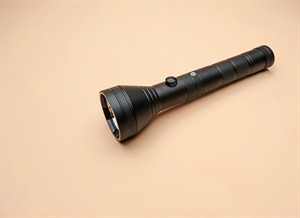
Torch light with switch
Step 1: Take a torchlight similar to the one shown in the above image.
Step 2: Observe the torch carefully and identify its main parts such as the lamp (bulb) and the switch.
Step 3: Slide the switch to one position and observe the lamp.
Step 4: Slide the switch back to its original position and again observe the lamp.
Step 5: Open the torchlight carefully and observe the components present inside it.
Observation:
When the switch is in the first position, the torch lamp glows. When the switch is moved back to the other position, the lamp does not glow. On opening the torchlight, two or more electric cells are found inside it.
Conclusion:
The torchlight works only when the switch is turned ON, allowing electric current from the cells to flow through the lamp and make it glow. When the switch is OFF, the circuit is incomplete and the lamp does not glow.
Torch:
A torch is an electrical device that works using electric cells and produces light when the switch is turned ON, allowing electric current to flow through the lamp and make it glow.
Let us perform an activity to understand more about the electric cells.
Activity: To observe the parts of an electric cell.
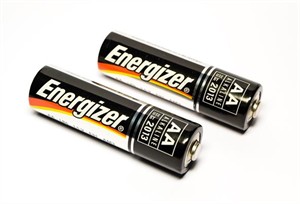
Cells
Step 1: Take an electric cell.
Step 2: Turn the cell around and observe it carefully from all sides.
Step 3: Look for the markings on thecell.
Step 4: Observe the two ends of the electric cell closely.
Observation:
A positive (\(+\)) sign and a negative (\(–\)) sign are marked on the electric cell. One end of the cell has a small protruding metal cap.The other end of the cell has a flat metal disc.
Conclusion:
An electric cell has two terminals, a positive terminal and a negative terminal, which are clearly marked. These terminals help in the proper connection of the cell in an electric circuit.
Electric cell:
An electric cell is a portable source of electrical energy that has two terminals, a positive terminal and a negative terminal, which help in the proper connection of the cell in an electric circuit. The raised metal cap forms the positive terminal, while the flat metal disc acts as the negative terminal.
A cell with terminals
Activity: To observe the functions of battery.
Step 1: Take a torch that uses two electric cells.
Step 2: Open the cell compartment of the torch and remove the cells.
Step 3: Place the cells back into the torch in a different order.
Step 4: Reverse the direction of one cell and insert them again.
Step 5: Slide the switch each time and check whether the lamp glows.
Step 6: Finally, place the cells in the correct order and observe the arrangement.
Observation:
The lamp does not glowwhen the cells are placed in the wrong order or when one cell is reversed. The lamp glows only when the positive terminal of one cell is connected to the negative terminal of the next cell.
Conclusion:
When two or moreelectric cells are connected such that the positive terminal of one cell is joined to the negative terminal of the next, they form a battery. Only in this proper arrangement can the battery supply electrical energy to make the lamp glow.
Battery:
A battery is formed when two or more electric cells are connected such that the positive terminal of one cell is joined to the negative terminal of the next, enabling it to supply electrical energy to a circuit.
Need for a battery:
Many electrical devices require more than one electric cell to operate. Therefore, two or more cells are connected together. Using multiple cells supplies electrical energy to the circuit for a longer duration and can also provide greater energy when required.
Use of the term “Battery”:
The word battery is often used even when there is only a single cell. For example, the power source used in mobile phones is commonly called a battery, although it may consist of just one cell.
Activity: To observe the function and parts of an incandescent lamp.
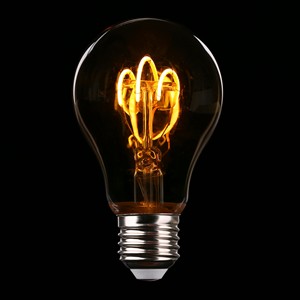
An incandescent lamp
Step 1: Take a torchlight that uses an incandescent lamp.
Step 2: Examine the lamp carefully without switching it on.
Step 3: Observe the glass bulb and look for a thin wire inside it.
Step 4: Switch on the torch and observe which part of the lamp glows.
Step 5: With your teacher’s help, remove the lamp from the torch and inspect it from all sides.
Step 6: Observe how the thin wire is fixed and how it is connected at the base of the lamp.
Observation:
A thin wire is present at the centre of the glass bulb. When the torch is switched on, this thin wire glows.
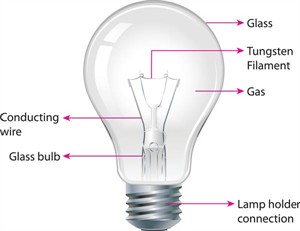
The thin wire is attached to two thicker supporting wires.
One thick wire is connected to the metal case at the base of the lamp, and the other is connected to the metal tip at the centre of the base.
These two connections act as the two terminals of the lamp and do not touch each other.
Conclusion:
The thin wire inside the glass bulb is called the filament. In an incandescent lamp, electric current passes through the filament, causing it to become very hot and glow, thereby producing light.
Incandescent lamp:
An incandescent lamp is a device in which electric current passes through a thin wire called a filament, causing it to become very hot and glow, thereby producing light.
Parts of an incandescent lamp
Activity: To observe the parts and function of an LED.
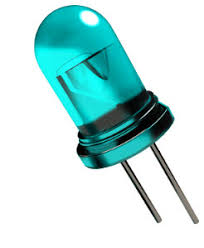
LED with the terminals
Step 1: Take an LED of any colour and observe it carefully.
Step 2: Look inside the LED and check whether you can see any filament.
Step 3: Observe the two wires attached to the LED.
Step 4: Compare their lengths and note whether one wire is longer than the other.
Observation:
No filament is seen inside the LED.
The LED has two terminals.
One terminal is connected to a longer wire, and the other to a shorter wire.
The longer wire represents the positive terminal, while the shorter wire represents the negative terminal.
A torch lamp may contain one or more LEDs, sometimes of different shapes.
Conclusion:
Unlike incandescent lamps, LEDs do not use filaments to produce light. They have two terminals with fixed polarity, and correct connection is required for them to glow.
LED:
An LED (Light Emitting Diode) is an electric device that produces light without the use of a filament. It has two terminals with fixed polarity, represented by a longer wire for the positive terminal and a shorter wire for the negative terminal.