Electric devices work only when electric current flows through a complete circuit. By performing simple activities using electric cells, bulbs, LEDs, and connecting wires, we can understand how an electric circuit is formed and how current flows through it. They also explain why an incandescent lamp may fuse and why LEDs glow only in one direction.
Electrical circuit:
An electric lamp glows when one terminal of the lamp is connected to one terminal of the electric cell, and the other terminal of the lamp is connected to the other terminal of the cell. This arrangement forms an electrical circuit.
Flow of electric current:
An electrical circuit provides a complete path through which electric current can flow. The lamp glows only when electric current passes through the circuit.
Direction of electric current:
By convention, the direction of electric current in a circuit is taken from the positive terminal to the negative terminal of the electric cell.
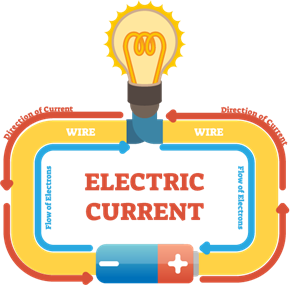
Direction of electric current
Glowing of an incandescent lamp:
When the terminals of the lamp are connected to the terminals of the electric cell using wires, electric current flows through the filament of the incandescent lamp, causing it to glow. In an incandescent lamp, it does not matter which terminal is connected to the positive or negative terminal of the cell. The lamp will glow as long as the circuit is complete and current flows through the filament.
Fused lamp and broken filament:
Sometimes, an incandescent lamp does not glow even when it is properly connected to a cell. In such cases, we say that the lamp has fused, which usually happens due to a broken filament. A broken filament interrupts the flow of electric current, preventing the lamp from glowing.
Connecting cells placed side by side:
Sometimes, you may find a device where the cells are placed side by side. In such cases, the terminals of the cells are connected using a thick wire or metal strip that joins the positive terminal of one cell to the negative terminal of the next. To ensure correct placement, (\(+\)) and (\(-\)) symbols are usually printed inside the battery compartment.