

Reflection of light:
The change in the direction of light after striking a mirror is called the reflection of light.
Light's reflection and its path:
- The path of a light beam changes after falling on a mirror.
- Light does not pass through the mirror; instead, it bounces off in a different direction.
- Reflection of light occurs at the surface of the mirror.
Properties of a plane mirror:
-
The image formed is virtual ( it cannot be projected on a screen).
-
The image is of the same size as the object.
-
The image is laterally inverted (left and right are reversed).
-
The image appears at the same distance behind the mirror as the object is in front.
-
The image is upright (top and bottom are not inverted).
-
A plane mirror follows the laws of reflection.
Lateral inversion:
Lateral inversion is the left–right reversal seen in the image formed by a plane mirror, where the left side of an object appears on the right side of the image, and the right side appears on the left.
Pinhole camera:
A pinhole camera is a simple device that forms an image by allowing light to pass through a tiny hole.
Periscope:
A periscope is an optical device that uses two plane mirrors to help us see objects that cannot be seen directly because they are blocked from direct sight.
How to make a periscope:
- Make a Z-shaped box.
- Fix two plane mirrors inside the box at \(45^{\circ}\) angles, as shown in the figure.
- Light reflects from the first mirror to the second, and then to the viewer’s eyes.
- A single, clear image of the object is formed.
- The image formed is virtual and erect.
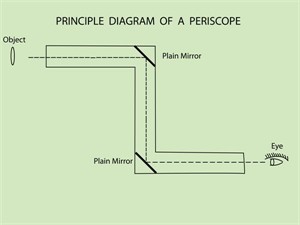
Periscope
Uses:
- Used in submarines to see above the water surface.
- Used in tanks and bunkers by soldiers to observe outside safely.
- Can be used by a person to see over tall objects or other people.
Kaleidoscope:
A kaleidoscope is an instrument that uses three mirrors to create beautiful and changing patterns through repeated reflections.
How to make a kaleidoscope:
- Join three rectangular plane mirrors to form a triangular shape.
- Place the mirrors inside a cylindrical tube made of thick chart paper.
- Fix a transparent plastic sheet on one end of the tube.
- Place small pieces of coloured bangles or beads on the plastic sheet.
- Cover these pieces with tracing paper.
- Look through the open end of the tube to observe the patterns.
- Multiple repeated and symmetrical images are formed.
- The images formed are virtual and display colourful patterns.
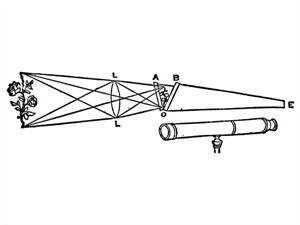
Construction of a kaleidoscope
Uses:
- Produces colourful, changing patterns for fun and creativity.
- Helps designers and artists generate ideas for new patterns.
- Demonstrates how multiple reflections (reflections of reflections) can create repeated designs.
Important!
A pinhole camera forms an inverted image, whereas mirror produces lateral inversion, meaning the left and right are reversed, but the image remains upright.