

Sources of light:
Objects that emit light are called sources of light. These can be natural or artificial.
Natural sources of light:
The Sun gives out or emits its own light and is the main source of natural light on Earth.
Other natural sources of light include stars, lightning, natural fire, and even some animals that glow on their own.
Other natural sources of light include stars, lightning, natural fire, and even some animals that glow on their own.
Early artificial light:
In ancient times, humans learned to create fire, the earliest form of artificial lighting.
Later, they discovered ways to produce fire using different fuels such as animal fat, oil, wax, and gas.
Later, they discovered ways to produce fire using different fuels such as animal fat, oil, wax, and gas.
Modern artificial light:
With the invention of electricity, humans created many new light sources.
Today, most of our lighting needs are met by electric lamps, bulbs, LED bulbs and other electric lights.
Today, most of our lighting needs are met by electric lamps, bulbs, LED bulbs and other electric lights.
Luminous objects:
Objects that emit or give out their own light are called luminous objects.
Example:
The Sun, stars, and glowing fireflies.
Non-Luminous objects:
Objects that do not emit their own light are called non-luminous objects.
They can only be seen when light from luminous objects falls on them and is reflected.
They can only be seen when light from luminous objects falls on them and is reflected.
Example:
The Moon shines because it reflects sunlight.
LED (Light Emitting Diode) lamps are modern sources of light that use much less electricity, shine brighter, and last longer than traditional bulbs. They help reduce electricity bills and are better for the environment. Because of these benefits, the Indian government has encouraged people across the country to use LED lamps. When LED lamps stop working, they should be properly disposed of or recycled, not thrown into regular garbage.
Transparent:
Materials that allow light to pass completely through them are called transparent.
Example:
Glass, clear water.
Translucent:
Materials that allow light to pass partially are called translucent.
Example:
Butter paper, wax paper.
Opaque:
Materials that do not allow light to pass through are called opaque.
Example:
Brick wall, cardboard, metal door.
Shadow:
A shadow is a dark patch formed when an opaque object blocks the path of light, which travels in a straight line. It is always formed at the opposite side of the light source.
- Opaque objects form dark shadows because they do not allow light to pass through.
- Translucent objects form light or faint shadows as they let some light pass through.
- Transparent objects form very faint or no shadows because most of the light passes through them.
Activity:
To observe the shape and size of shadows formed by opaque objects.
Step 1: Collect a few opaque objects of different shapes and sizes.
Step 2: Using a torch, a screen and each object one by one, observe how shadows are formed.
Step 3: Carefully watch the shape and size of the shadow on the screen and record the observations.
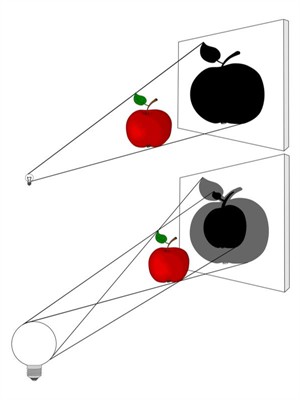
Shadow formation
Observation:
| Action | Observation regarding shadow |
| The screen is removed. | No shadow is formed because there is no surface for the shadow to fall on. |
| The object is removed. | No shadow is formed because nothing blocks the light. |
| The torch is switched off. | No shadow is formed because there is no light source. |
| The colour of the object is changed. | The colour of the shadow does not change; it remains dark. |
| The object is moved closer to the screen, keeping the torch and screen fixed. | The shadow becomes smaller and sharper. |
| The object is moved closer to the torch, keeping the torch and screen fixed. | The shadow becomes larger and less sharp. |
| The object is tilted, keeping the torch and screen fixed. | The shape of the shadow changes according to the object’s tilt. |
Conclusion:
- A shadow is formed when an object blocks light from falling on a screen.
- To observe a shadow, we need a source of light, an opaque object, and a screen.
- The shape, size, and sharpness of a shadow depend on the position of the object relative to the light source and the screen.
- Changing the colour of the object does not change the colour of its shadow.