It was a sunny afternoon, and Dave and Eira decided to fly their kites in the open field. The wind blew steadily, helping their kites soar higher. Sometimes the wind was strong, making it hard to hold the strings, and other times it was gentle, allowing smooth control. As dark clouds appeared in the distance, they decided to pack up. While running to reel in their kites, the wind suddenly pulled the strings strongly, making the kites dart forward on their own.
 
The movement of the kites is caused by the force of the wind, showing how forces can change motion.
Activity: To understand that a push or a pull is needed to move an object.
 
forcew702.png
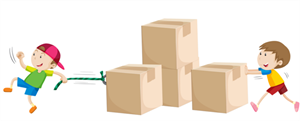
Pushing and pulling cardboard boxes
 
Step 1: Take a large cardboard box and place it on the floor.
Step 2: Try moving the box in different ways, such as pushing it forward, pulling it toward you, or sliding it sideways.
Step 3: Observe whether the box can be moved in more ways.
 
Observation:

The box moves only when it is pushed or pulled. It can be moved in different directions depending on how the push or pull is applied.
 
Conclusion:

In every method used to move the box, a push or a pull was necessary. In science, such a push or pull applied on an object is called a force.
 Let us perform one more activity to identify the push and pull force in everyday situations.
Activity:  To identify pushes and pulls in everyday situations and observe the effects of force on objects.
 
Step 1: Think of different everyday situations where a push or a pull is applied on an object.
Step 2: List these situations in the table.
Step 3: Identify whether the action is a push or a pull.
Step 4: Observe the effect of each force, such as stopping an object, changing its speed or direction, or changing its shape.
 
S.No. Action Push/Pull Effect
1. Your friend holding your moving bicycle from behind to stop it Pull Stopping or decreasing the speed of the bicycle
2. Hitting a moving ball with a bat Push Changing the direction of the moving ball
3. Pressing an inflated balloon Push Change in the shape of the balloon
4. Pulling a drawer to open it Pull Bringing the drawer into motion
5. Pushing a door to close it Push Changing the position of the door
6. Stretching a rubber band Pull Change in the shape and length of the rubber band
 
Observation:
 
From the table, it is seen that a force can start or stop motion, change the speed of an object, change its direction, or change its shape. Different actions produce different effects depending on how the force is applied.
 
Conclusion:
 
Force plays an important role in changing the state of an object. It can cause a moving object to stop, change its speed or direction of motion, and even change the shape of an object.

Effect of force in everyday life:
 
In our daily activities, we often apply force in different forms such as opening a drawer, stretching a rubber band, stopping a moving ball, kicking a football, applying brakes on a bicycle, rolling a chapati, or turning the steering handle of an autorickshaw. These actions involve either a push or a pull.
 
shutterstock1055613149w600.jpg
A player kicking a football
 
Effects of applying force on objects:
 
The application of force on an object can produce the following effects.
 
Starting motion:

A force can make a stationary object move, such as pushing a door to open it.
 
shutterstock1760896106w600.jpg
A man pushing a door to open
 
Changing speed:

A force can increase or decrease the speed of a moving object, like applying brakes to slow down a bicycle.
 
shutterstock1316331548w600.jpg
A man applying brakes on a bicycle
 
Changing direction of motion:

A force can change the direction in which an object is moving, for example, hitting a moving ball with a bat.
 
Changing shape:

A force can change the shape of an object, such as stretching a rubber band, squeezing a lemon or rolling a chapati.
 
shutterstock521097904w400.jpg
Squeezing a lemon
 
Producing multiple effects:

In some cases, a force may cause more than one effect at the same time.

Interaction between objects:
 
When you push a table, your hand applies a force on the table. In this situation, your hand and the table are two objects that interact with each other. This interaction results in the application of force.
 
Objects involved in applying force:
 
In all the actions, there are always at least two objects involved. For example, a bat and a ball, a hand and a drawer, or a foot and a football. Force is produced only when two objects interact with each other in some way.
 
From these examples, we can infer that a force comes into existence only when there is interaction between two objects. A single object by itself cannot produce a force.
 
Force:
A force is defined as a push or a pull on an object resulting from its interaction with another object.
Unit of force:
 
The SI unit of force is the newton, written with a small ‘n’, and its symbol is \(N\).
  
Forces acting on a stationary object:
 
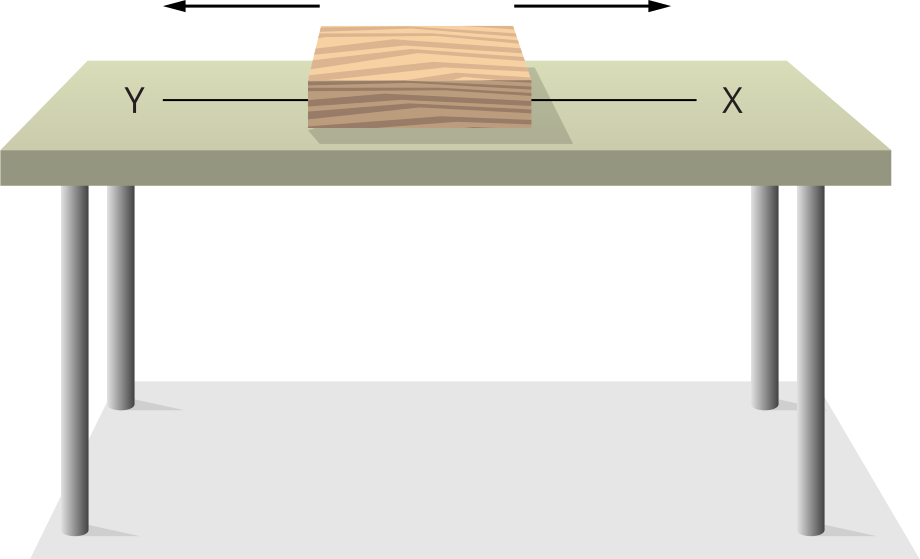
If an object is at rest, it does not mean that no force is acting on it. Instead, it means that the forces acting on the object are balanced. When forces balance each other, there is no change in the state of rest or motion of the object.
 
table1.svg
Balanced force acting on the wooden block
 
Forces act in pairs:
  • When you push a table or car with your hand, you also feel a force acting on your hand.
  • This force exists only as long as you are pushing the table or car.
  • The moment you stop pushing, the force on your hand disappears.
  • This shows that whenever two objects interact, each object experiences a force exerted by the other.
  • When the interaction between the two objects stops, the forces acting on them also cease.
 
 shutterstock463419026w600.jpg
A man pushing a car with his hands