

Phases of Moon:
The Moon does not produce its own light. It shines because it reflects the light of the Sun. The Moon is always half illuminated by the Sun, but from Earth, we see only the illuminated part that faces us. As the Moon revolves around the Earth, the visible illuminated portion changes.
Phase of the Moon:
The shape of the bright portion of the Moon that we see from Earth is called a phase. The Moon does not change shape, only the lit part we see changes.
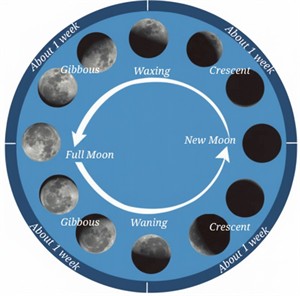
Phases of Moon
Main phases:
New Moon (Amavasya): The illuminated side faces away from Earth, so the Moon is not visible.
Full Moon (Purnima): The illuminated side fully faces Earth, and we see a complete bright circle.
Crescent: Only a small part of the Moon is visible.
Gibbous: More than half is visible, but it is not full.
Waxing and Waning:
Waxing: The illuminated portion increases (from New Moon to Full Moon). In India, this is called Shukla Paksha.
Waning: The illuminated portion decreases (from Full Moon to New Moon). In India, this is called Krishna Paksha.
Moon cycle:
The Moon goes through a waning period followed by a waxing period in a cyclical manner. The complete cycle from one full Moon to the next takes about one month. This is called the Moon cycle.
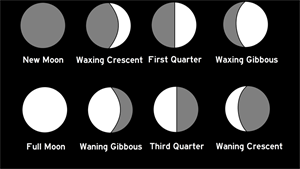
Moon cycle
Why Moon phases occur:
Moon phases are not caused by Earth’s shadow. They occur because of the changing positions of the Sun, Earth, and Moon as the Moon revolves around the Earth.
- The side facing the Sun is illuminated.
- The side facing away is dark.
- We see only the illuminated part facing Earth.
- Earth’s shadow falling on the Moon causes a lunar eclipse, not regular phases.
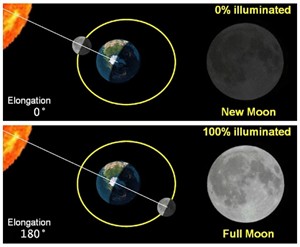
Illuminated and non-illuminated parts of Moon
Locating the Moon in the sky:
The Moon’s position changes daily because it moves forward in its orbit while the Earth rotates.
- On a Full Moon day, the Moon rises when the Sun sets.
- A waxing Moon is best seen at sunset.
- A waning Moon is best seen at sunrise.
- The Moon rises about \(50\ \text{minutes}\) later each day.
- Moonrise may occur during the afternoon.
Why eclipses do not occur every month:
Although a lunar eclipse can occur only on a Full Moon and a solar eclipse only on a New Moon, eclipses do not happen every month. This is because the Moon’s orbit is slightly tilted compared to Earth’s orbit around the Sun, so they do not line up perfectly every time.
Measurement of time:
Mean Solar day:
The Sun takes about \(24\) hours to return to its highest position in the sky on two successive days. This average interval is called the mean solar day. The shortest shadow of an object indicates the Sun’s highest position.
Solar year:
A solar year is the time taken by the Earth to complete one revolution around the Sun, about \(365\tfrac{1}{4}\ \text{days}\). This revolution causes the seasons.
Tropical Year and Sidereal Year:
Tropical Year: Time between two successive spring equinoxes (used in Gregorian calendar).
Sidereal Year: Time taken for Earth to return to the same position relative to distant stars.
The sidereal year is about \(20\) minutes longer than the tropical year.
Leap year:
Since Earth takes about \(365\tfrac{1}{4}\ \text{days}\) to orbit the Sun:
- One extra day is added every \(4\ \text{years}\).
- Years divisible by \(4\) are leap years.
- Century years are leap years only if divisible by \(400\).
- This keeps the calendar aligned with seasons.