

In the last few chapters, we have discussed,
- different ways of describing the motion of objects and
- the cause of motion and gravitation.
Another important concept that encourages us to understand and explain many natural phenomena is ‘work’, which is closely related to energy and power.
In this chapter, we shall discuss work and energy.
What do they need for their work (Process or activity)?
Why do some engines require fuel like petrol and diesel?
Why do living beings and machines need energy?
If we answer the above questions, we get an overview of Work and Energy.
We require energy for other activities such as playing, singing, reading, speaking, writing, thinking, jumping, cycling, running, etc.
The more the work is complex, the more it requires energy. Machines are also needed fuels to get the energy to complete their works.
You are working hard to push a large rock. Let us say the rock does not move an inch despite all the effort put in by you. You get exhausted fully. But, you have not performed any work on the rock as there is no displacement of the rock.
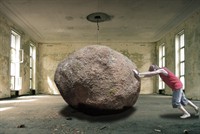
No displacement
You are walking through the steps of a staircase and reach the third floor of a building just to see the scene from there.

You may even climb up a tall tree
If we use the scientific definition, the above two activities involve a lot of work. Activities such as playing on the ground, interacting with friends, humming a tune, watching a movie, attending a function are sometimes not considered work.
Example 1 - Carrying a box

carrying a box
In the case of carrying a box, you are using a vertical force to lift a box while you are moving horizontally in the distance. This indicates zero work is being done as the force and distance are not applied in the same direction.
Example 2 - A book falls off a table (free falls to the ground)
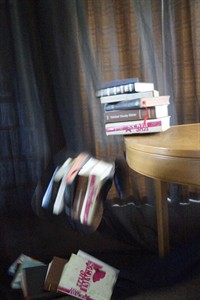
Book fall from table
This is an example of work. There is a force (gravity) that acts on the book, which causes it to be displaced in a downward direction (i.e., "fall").
Example 3 - A man applies a force on a wall and gets exhausted

Pushing a wall
This is not an example of work. The wall is not displaced. A force must cause a displacement 'for the work to be done'.
When the object moves at a constant velocity, the net force acting on the object is zero. But, there is a displacement along with the movement of the object. Hence, there can be a displacement of the object without a force. Object moves at a constant velocity
A closer look at the above scenarios shows that two conditions require to be satisfied for work to be done:
- A force should act on an object, and
- The object must be relocated or displaced.
If any one of the above-said conditions does not exist, work is not done. This is the way we view the term 'work' in science.