

How is 'work' defined in science?
To understand this, we shall first consider the case when the force is acting in the direction of displacement.
Let us consider,
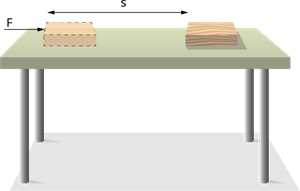
Work done
F → Constant force acting on an object
s → Displacement of the object in the direction of the force.
W → Work done.
Work is calculated as the product of the force and displacement.
\(Workdone\ =\ Force\ \times\ Displacement\)
\(W\ =\ F\ \times\ s\)
Work done by a force acting on an object is equal to the magnitude of the force multiplied by the distance moved in the direction of the force. Work has only magnitude and no direction.
If F = 1 N, and s = 1 m then, the work done by the force will be 1 Nm.
Here the unit of work is Newton metre (Nm) or Joule (J). Thus, 1 J is the amount of Work done on an object when a force of 1 N displaces it by 1 m along the line of action of the force.
Consider the scenario in which an object moves with a uniform velocity along a particular direction. Retarding force, F, is applied in the opposite direction to the object's movement. That is, the angle between the two directions is 180º. Let the object stops after a displacement s.
In such cases, the work done by the force, F, is taken as negative and denoted by the minus sign.
\(Workdone\ =\ Force\ \times\ Displacement\)
\(W\ =\ - F\ \times\ s\)
From the above discussion, the work done by a force can be either positive or negative.