


Prove that if a square is inscribed so that it shares a vertex with the right angle of an isosceles right triangle, then the vertex opposite this right angle bisects the hypotenuse.
Proof:
Let \(△ ABC\) be an isosceles triangle, a square \(ADEF\) is inscribed.
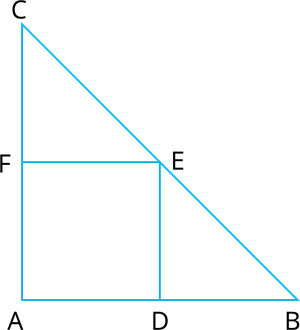
To prove: \(CE = BE\)
In the isosceles \(△ ABC\),
\(∠A=\) \(^{\circ}\) and \(AB =\) ----(1)
Since, \(ADEF\) is a square.
\(AD = \) [all sides of squares are equal] ----(2)
On subtracting (2) from (1),
\(AB − AD = AC − AF\)
That is, \(BD =\) ----(3)
Now, in \(△CFE\) and \(△BDE\),
\(BD = \) [From (3)]
\(DE = EF\) [sides of square]
Also, \(∠CFE=∠EDB=\) \(^°\)
Therefore, \(△CFE≅△\) [SAS congruence rule]
Hence, \(CE=\) []
Hence, proved.
\(AD = \) [all sides of squares are equal] ----(2)
On subtracting (2) from (1),
\(AB − AD = AC − AF\)
That is, \(BD =\) ----(3)
Now, in \(△CFE\) and \(△BDE\),
\(BD = \) [From (3)]
\(DE = EF\) [sides of square]
Also, \(∠CFE=∠EDB=\) \(^°\)
Therefore, \(△CFE≅△\) [SAS congruence rule]
Hence, \(CE=\) []
Hence, proved.