


\(ABC\) is an isosceles triangle in which \(AB = AC\). \(AD\) bisects exterior angle \(QAC\) and \(CD || AB\) (see below figure).
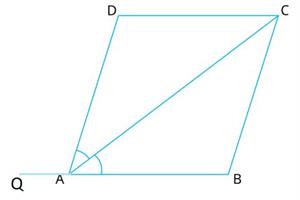
Show that
(i) \(∠ DAC = ∠ BCA \)
Proof:
\(∆ ABC\) is isosceles in which \(AB = AC\).
So, \(∠ ABC = ∠\) (Angles opposite to equal sides)
Also, \(∠ QAC = ∠ QBC + ∠ ACB\) (Exterior angle of a triangle)
That is, \(∠ QAC = 2∠\) ---- (1)
Now, \(AD\) bisects \(∠ QAC\).
So, \(∠ QAC = 2∠\) ----- (2)
Therefore, \(2∠ DAC = 2∠ ACB\) [From (1) and (2)]
That is, \(∠ DAC = ∠ ACB\)
Hence, proved.
(ii) \(ABCD\) is a parallelogram.
Proof:
Now, these equal angles form a pair of alternate angles when line segments \(BC\) and \(AD\) are intersected by a transversal \(AC\).
So, \(BC || AD\)
Also, \(BA ||\) (Given)
Now, both pairs of opposite sides of quadrilateral \(ABCD\) are parallel.
So, \(ABCD\) is a parallelogram.