

Prove that the parallelogram circumscribing a circle is a rhombus.
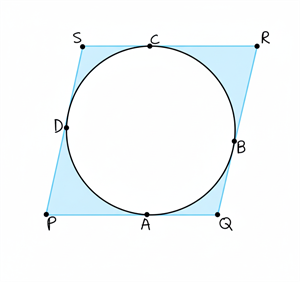
Proof:
We know that, the lengths of tangents drawn from an external point to a circle are equal.
\(PA = \) ----(1)
\(QA = \) ----(2)
\(RC = \) -----(3)
\(SC = \) -----(4)
By, adding (1), (2), (3) and (4) RHS = LHS, we get
\(PA + QA + RC + SC = PD + QB + RB + SD\)
\((PA + QA) + (RC + SC)\) \(= (PD + SD) + (QB + RB )\)
\( + RS = PS +\)
As \(PQRS\) is a, \(PQ= RS\) and \(PS = QR\)
Hence, \(2 PQ = 2QR\)
\(PQ = QR\)
If the of a parallelogram are equal, then it is a rhombus.
Hence, \(PQRS\) is a rhombus.